Spider populations in Western New York accelerate between August and October, driven by mating activity and dropping temperatures along Lake Erie. In historic Buffalo housing stock, particularly Victorian properties in…
Spider populations in Western New York accelerate between August and October, driven by mating activity and dropping temperatures along Lake Erie. In historic Buffalo housing stock, particularly Victorian properties in Elmwood Village, brick doubles in Allentown, and stone-foundation bungalows in North Buffalo, fieldstone mortar joints, damp dirt-floor cellars, and unsealed ribbon joists offer ideal harborages. Spiders enter living areas not to target humans, but to hunt active secondary insect populations such as fungus gnats, silverfish, and cluster flies attracted to basement moisture.
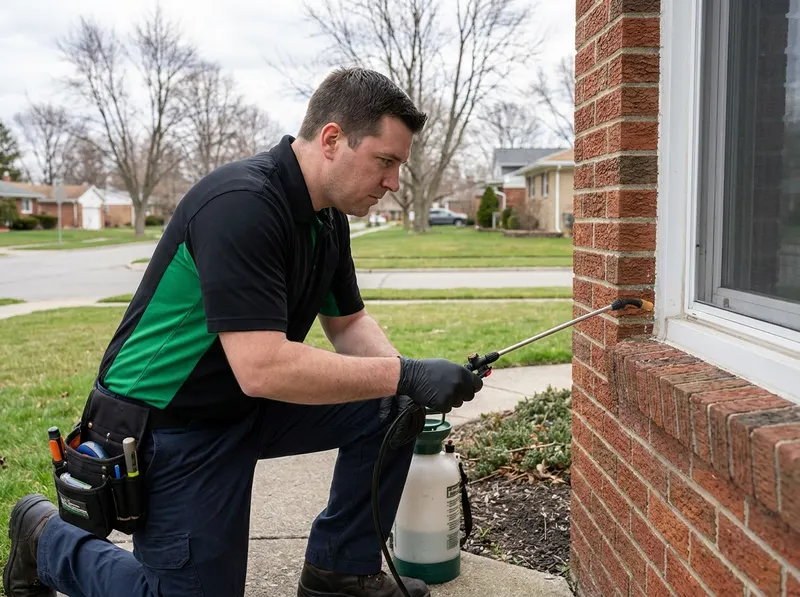
Controlling spiders requires disrupting this predatory supply chain rather than saturating living spaces with indiscriminate aerosol sprays. Standard retail insecticides fail because arachnids hold their bodies above treated surfaces on long legs, absorbing minimal product through their tarsi. Structural remediation focuses on physical exterior exclusion: sealing gaps around water penetrations, utility conduits, and basement hopper windows along properties near Delaware Park and Black Rock. A targeted wettable micro-encapsulated powder applied directly beneath siding courses and around sill plates creates an insect-free boundary that deprives spiders of food, forcing them out.
Decision guidance depends on property construction. A standard single-family residential treatment fits dry, modern poured-concrete foundations; older fieldstone and rubble foundations in the West Side, Fruit Belt, or First Ward require an initial deep mechanical cleanout with specialized HEPA-filtration vacuums alongside exterior point-of-entry caulking. The operational trade-off is surface longevity versus immediate knockdown: liquid perimeter residuals offer rapid reduction within 72 hours, whereas silicone elastomeric sealants deliver multi-year mechanical exclusion but require dry, warm curing conditions above 40 degrees Fahrenheit.
1. Initial structural audit: Technicians inspect basement sills, attic eaves, and window wells to identify spider harboring sites and localized moisture sources.
2. Mechanical de-webbing: High-reach telescoping brushes and HEPA extraction clear active webs, egg sacs, and resting adults from soffits and floor joists.
3. Precision perimeter boundary: Technicians place targeted low-toxicity botanical or synthetic pyrethroid treatments along exterior base courses and basement wall-floor junctions.
4. Prey reduction guidance: Technicians document plumbing leaks or floor-drain issues to eliminate the secondary pests sustaining the arachnids.
Every job gets a firm, written price after a free on-site visit.
Tell us about your spider control job in Buffalo and we'll send a clear, written quote, usually the same day.
 Gravion Pest Control